 Corewell Systems
Healthcare
Patient records, appointments, billing, and care coordination, in systems built for how clinics and hospitals actually run.
The operational problem
A clinic's day is a chain of handoffs, front desk to doctor to billing, and every handoff leaks time when records live in filing cabinets, spreadsheets, and memory. Double-booked appointments, missing histories, unbilled visits: none of it is a people problem. It's a systems problem. A purpose-built platform keeps every patient, appointment, and invoice connected, so the chain doesn't break. This is the industry we have built in most deeply: clinical platforms running in daily practice, not concepts.
What the system covers
- Patient records & charting
- Appointments & scheduling
- AI clinical documentation
- Insurance & eligibility
- Claims & revenue cycle
- Patient portal & intake
- Kiosk check-in & consents
- Telehealth
- Payments & plans
How the system connects
- Hospital
- Doctor
- Patient
- Appointment
- Invoice
Who we build this for
Healthcare is not one workflow. We have built systems for each of these, and they differ in ways that matter.
Primary care, internal medicine, and specialty clinics
Clinics & Medical Practices
A complete operating system for outpatient care, from the front desk to clinical documentation to the money that follows the visit.
How the work flows
- Book
- Check in
- Consult
- Document
- Code
- Bill
- Collect
- Guided encounter workspace that walks a provider from vitals to checkout
- Clinical notes dictated by voice or generated from the visit itself
- Insurance verified in real time before the patient is in the room
- Card payments and payment plans built into the visit, not bolted on
What the software does
Every capability below exists in a system we have designed and built. Open a section to see the detail.
Patient records & clinical charting
One chart per patient that every authorized person sees the same way.
Patient records & clinical charting
One chart per patient that every authorized person sees the same way.
- Complete patient record: demographics, insurance, contacts, and history in one place
- Problem list, allergies, medications, immunizations, and family and social history, each with its own review workflow
- Nothing is ever silently deleted: every change to a clinical record requires a reason and is recorded
- Clinical notes from clinic-authored templates, signed electronically
- Corrections after signature handled properly: amendments and addenda with a defined window, full version history, and billing held until the record settles
- Document vault with encrypted storage for scans, referrals, and results
AI clinical documentation
The note writes itself while the clinician stays with the patient.
AI clinical documentation
The note writes itself while the clinician stays with the patient.
- Ambient recording of the visit, transcribed and turned into a draft note in the clinic's own template
- Recording built for the real world: it survives a locked phone screen, a dropped connection, or a disconnected microphone, and resumes where it left off
- Voice entry for structured fields, so a provider can dictate straight into the chart
- Diagnosis and procedure codes suggested from the note, with the reasoning shown
- Patient-friendly visit summaries generated automatically, written in plain language
- Patient identifiers are stripped before anything reaches an AI model, a compliance requirement we engineered for rather than an afterthought
Scheduling & clinic operations
The day runs from one screen and stays accurate in real time.
Scheduling & clinic operations
The day runs from one screen and stays accurate in real time.
- Multi-provider, multi-location calendar with per-site time zones
- Recurring appointment series with automatic conflict detection
- Check-in and check-out, including approval workflows when the front desk needs to correct a mistake
- Appointments that run long can be extended in place without breaking the rest of the day
- Automated appointment reminders ahead of the visit
- Provider schedules, time-off requests, and approvals
- Live updates across every open screen, with no refreshing to see the truth
Insurance & revenue cycle
From eligibility check to paid claim, without leaving the system.
Insurance & revenue cycle
From eligibility check to paid claim, without leaving the system.
- Real-time insurance eligibility: plan, network status, copay, coinsurance, deductible met, and out-of-pocket maximum
- Prior authorization tracking with visit counts and expiry warnings
- Charge capture generated from the signed note, not re-entered
- Industry-standard claim forms produced and submitted electronically to the clearinghouse
- Payer responses and remittance advice ingested automatically, so claim status and payments post themselves
- Accounts-receivable aging, patient ledgers, refunds, and denial tracking
Patient experience
Patients arrive prepared, and stay connected after they leave.
Patient experience
Patients arrive prepared, and stay connected after they leave.
- Patient portal: upcoming visits, medications, results, documents, balances, and visit summaries
- Self-scheduling with live availability, so booking doesn't require a phone call
- Digital intake completed on the patient's own phone, on a clinic tablet, or by staff: one system, and the record shows who entered what
- Lobby check-in kiosk running on real hardware, with consent forms signed on the spot
- Secure two-way messaging between patients and their care team
- Video visits with a waiting room, identity verification, and background privacy
Payments & collections
Getting paid is part of the visit, not a separate chase.
Payments & collections
Getting paid is part of the visit, not a separate chase.
- Card payments online and in the clinic, with the practice holding its own merchant account
- Tap-to-pay on a tablet, with no separate card terminal to buy or maintain
- Copay reminders with a secure pay-by-link
- Payment plans that charge automatically on schedule
- Patient balances handled with real accounting behaviour: credit on account, funds reserved against plans, and overpayment confirmation
Built for the rules you operate under
Handling patient data is a legal responsibility before it is a technical one. These are engineering decisions in the systems we have shipped, not promises.
Encryption that doesn't break search
Sensitive patient fields are encrypted in the database, yet staff can still search by name or phone, solved with searchable-encryption indexes rather than by leaving data exposed.
Every access recorded
Creates, updates, deletes, and even reads of patient data are logged with the user, the change, and the origin, then retained for six years by an automated policy.
Roles that mirror a real clinic
Separate permissions for clinicians, medical assistants and nurses, front desk, billers, administrators, and read-only auditors, enforced on the server rather than just hidden in the interface.
Isolation between organizations
Multi-clinic deployments are separated at three levels, down to database-enforced row-level security, so one organization's data cannot be reached from another even if application code were at fault.
Healthcare Management System: Interactive Demo
Explore a full clinical workflow (patient intake, scheduling, records, and billing) in a live interactive environment.
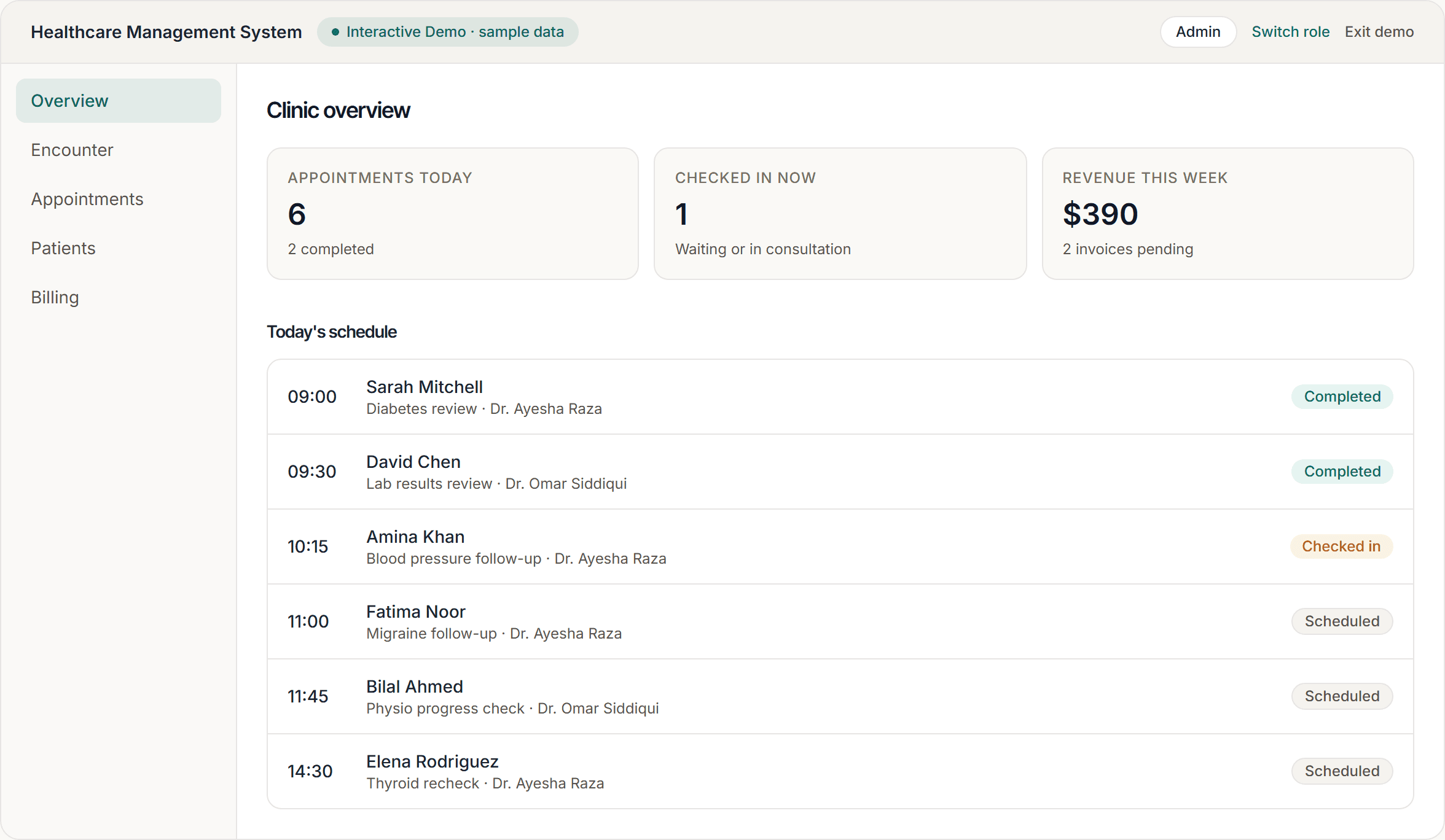
Open it now, with no signup and no credentials.
Choose a role and explore on sample data, the way your team would actually use it.
Proof, not promises
Four clinics kept four sets of paper files and their own booking spreadsheets. One system gives the network a single patient record, a shared appointment book, and billing tied to the visit.
Read the a multi-location clinic network case studyStraight answers
Healthcare software, answered plainly
The questions we get asked before anyone books a call. Short answers, no hedging.
Can a clinic system handle our insurance billing, or only appointments?
It handles the whole revenue cycle. The systems we have built verify a patient's coverage in real time before the visit, capture charges from the signed clinical note rather than by re-typing, produce standard claim forms, submit them electronically, and take in the payer's responses and remittances so claim status and payments post themselves.
How do we move years of paper records into a new system?
In phases, while you keep working. Migration is part of the build, not an afterthought: existing records are cleaned and imported, and we have moved live data into new storage in the background, with progress reporting, so nothing stopped while the change happened. Nobody has to key in a decade of files over a weekend.
Is patient data actually safe in a custom-built system?
It is safer than the filing cabinet and the shared spreadsheet it replaces, provided the system is built for it. In ours, sensitive fields are encrypted in the database while still remaining searchable, every create, update, delete and even read of a patient record is logged against a named user, access is separated by role and enforced on the server, and multi-organisation deployments are isolated down to the database itself.
Will doctors have to type more than they do now?
Less. Our systems include ambient documentation: the visit is recorded, transcribed, and drafted into a clinical note in the clinic's own template, which the clinician reviews and signs. Diagnosis and procedure codes are suggested from that note with the reasoning shown. Patient identifiers are removed before anything reaches an AI model.
Can patients book, check in, and pay without calling the front desk?
Yes. We have built patient portals with self-scheduling against live availability, digital intake completed on the patient's own phone or a clinic tablet, lobby check-in kiosks with consent forms signed on the spot, and card payments including tap-to-pay on a tablet rather than a separate card terminal.
More on healthcare software
- How Much Does Custom Healthcare Software Cost?Typical price ranges for clinic and hospital management systems, what drives the cost up or down, and how to scope a build so you pay for workflow.
- What Features Does a Clinic Management System Need?The features that decide whether a clinic system earns its cost, and the ones that get sold hard but change nothing about your day.
- Custom Software vs. Off-the-Shelf: How to Decide for Your BusinessA practical decision framework: when a ready-made tool is the right call, when a custom build wins, and how to compare the real five-year cost of each.